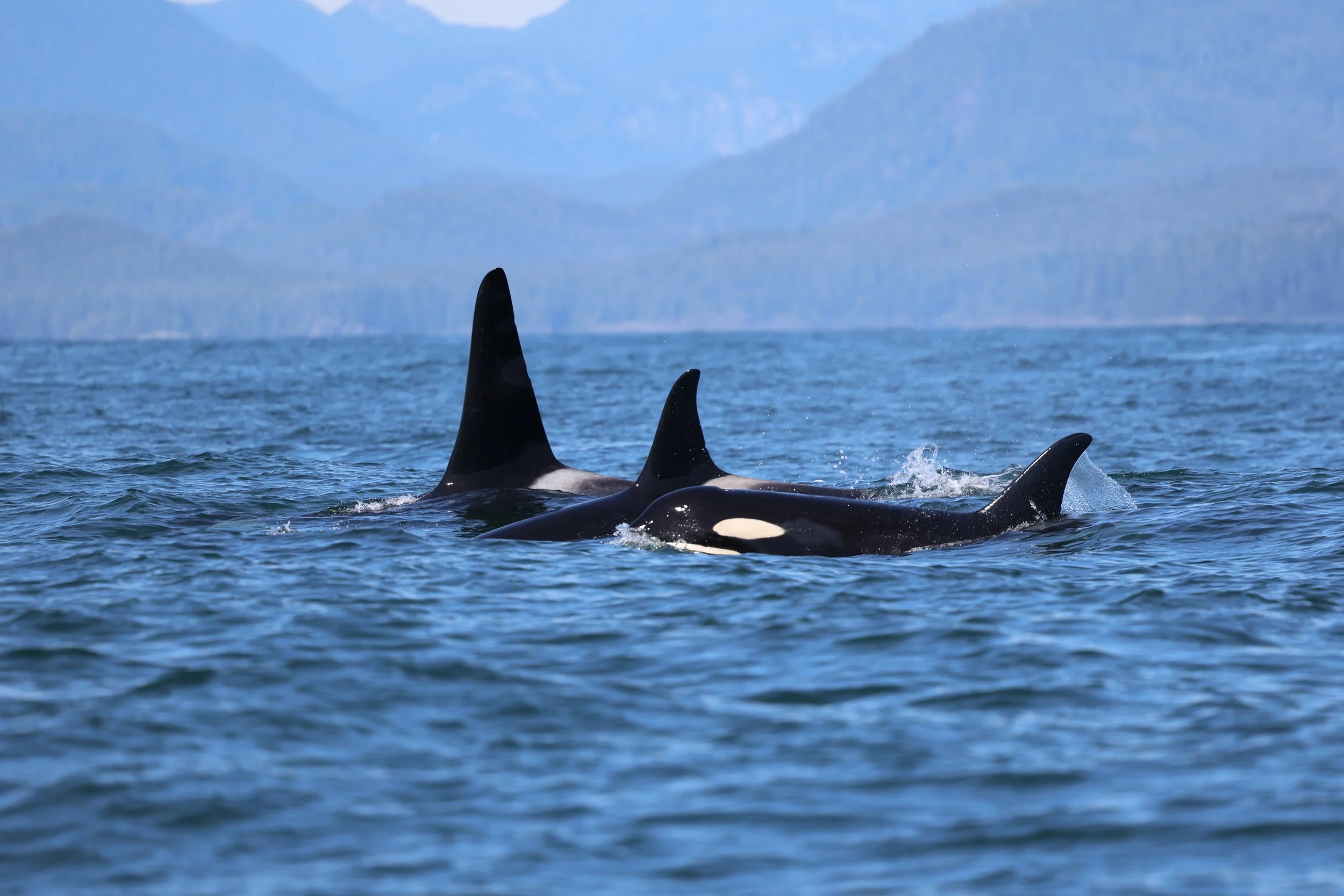
G12 Pod: The G2 and G27 Matrilines of the Northern Resident Killer Whales
Among the most remarkable wildlife visitors to the waters off Vancouver Island are the Northern Resident Killer Whales. These fish-eating orcas are known for their close family bonds, distinct vocal traditions, and lifelong connections to their matrilines.
Within the Northern Resident community’s G Clan, G12 Pod includes the G2 and G27 matrilines—two family groups connected through the larger pod structure and shared G Clan culture.
What Is a Matriline?
A matriline is a family group centred around a female ancestor. In Northern Resident Killer Whale society, both males and females typically remain with their mother and maternal relatives throughout their lives.
This means that when we see members of the G2 or G27 matrilines travelling together, we are witnessing generations of family: mothers, sons, daughters, siblings, and grandchildren moving through the ocean as a connected social group.
Northern Resident Killer Whales have one of the strongest known family structures in the animal world. Their relationships are not temporary—they are lifelong.
G12 Pod and the G Clan
G12 Pod is part of the G Clan, one of the three recognized clans within the Northern Resident Killer Whale community. Clans are linked by shared acoustic traditions, including distinctive calls that can help researchers identify which whales are present in an area.
Within a clan, pods are made up of related matrilines that may travel, forage, rest, and socialize together. The G2 and G27 matrilines are part of this larger G12 Pod family network.
While individual matrilines may sometimes travel separately, their shared social connections remain an important part of Northern Resident culture.
Fish-Eating Orcas of the West Coast
Northern Resident Killer Whales are very different from the mammal-eating Bigg’s killer whales that are also seen around Tofino and Clayoquot Sound.
Northern Residents feed primarily on salmon, with Chinook salmon being an especially important prey species. Their reliance on healthy salmon populations means that the wellbeing of these whales is deeply connected to the health of rivers, coastal ecosystems, and the Pacific Ocean.
They are also often more vocal than Bigg’s killer whales, using calls, whistles, and echolocation while travelling and foraging. Each clan has its own recognizable dialect, passed down through generations.
Why Seeing G12 Pod Is So Special
An encounter with the G2 or G27 matrilines is more than a chance to see killer whales in the wild. It is an opportunity to observe a highly social family whose members have shared the same coastal waters, travel traditions, and communication patterns for generations.
A line of dorsal fins moving through the ocean may look like a simple wildlife sighting from a distance. But each whale is part of a family story—one shaped by mothers, grandmothers, siblings, and the knowledge they share across a lifetime.
Protecting Northern Resident Killer Whales
Northern Resident Killer Whales are listed as Threatened in Canada. Their future depends on abundant salmon, clean water, healthy coastal habitats, and responsible vessel practices that reduce disturbance and underwater noise.
Respectful wildlife viewing is one way visitors can help. By giving whales space and allowing them to travel and feed naturally, we can enjoy unforgettable encounters while supporting the long-term protection of these extraordinary animals.
When G12 Pod is seen off the west coast of Vancouver Island, it is a powerful reminder that these waters are home to more than wildlife—they are home to families, cultures, and generations of Northern Resident Killer Whales.
Join us on the water and keep watch for the unforgettable sight of killer whales travelling through the wild waters of the Pacific coast of Tofino on Vancouver Island.